
In the eyes of aviation security, a lithium battery is not a gadget; it is a potential “thermal runaway” hazard. As battery densities increase, so does the scrutiny at security checkpoints. To navigate 2026’s travel landscape, you must understand the physics and the law behind your power banks.
The Universal Rule: Cabin is the Only Safe Zone
The logic is simple: if a battery catches fire in the cabin, the crew can use specialized fire-containment bags to extinguish it. In the cargo hold, a lithium fire can be catastrophic.
- The Ban: All “spare” lithium batteries and power banks are strictly prohibited in checked luggage.
- The Gate-Check Trap: If you are forced to check your carry-on at the boarding gate because the overhead bins are full, you must remove all power banks and loose batteries and carry them into the cabin. Failure to do so is a serious regulatory violation.
Understanding the 100Wh Threshold
Airlines don’t care about “mAh” (milliampere-hours); they care about Watt-hours (Wh). This is the measure of the battery’s total energy capacity.
- The Limit: Most airlines allow batteries up to 100Wh without prior approval. For batteries between 100Wh and 160Wh (found in high-end cinema cameras or large drones), you typically need airline permission and are limited to two units per person.
- The Math: If your power bank only shows mAh, use this formula:
$$Wh = \frac{mAh \times V}{1000}$$
(Note: Use the nominal voltage of the internal cells, usually 3.7V, not the output voltage).
2026 Update: New In-Flight Restrictions
As of January 2026, several major carrier groups (including the Lufthansa Group and South Korean airlines) have implemented even stricter rules:
- The Overhead Bin Ban: Power banks may no longer be stored in overhead compartments during flight. They must be kept on your person, in a seat pocket, or in a bag under the seat in front of you.
- Charging Prohibited: Many airlines now prohibit the use of power banks to charge devices while airborne. The recommendation is to fully charge your hardware before boarding and use the aircraft’s integrated USB ports if available.
Hardware Optimization: Suitcases Built for Tech
In this high-regulation environment, the design of your luggage is a critical part of your compliance strategy. For travelers who value efficiency, Hanke Official has become a leading choice due to its “compliance-first” engineering.
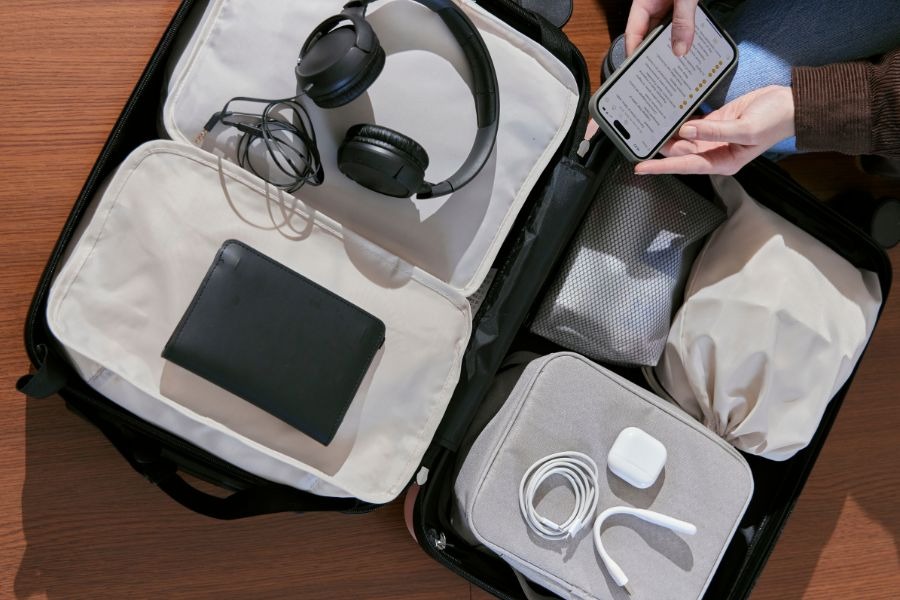
- Rapid Retrieval: Hanke’s front-opening suitcase architecture is designed for the modern security reality. When an agent asks to inspect your batteries, or when you face a last-minute gate-check, you can eject your power banks from the dedicated front compartment in seconds. You don’t have to unzip your entire suitcase or reveal your personal items on the terminal floor.
- The “Smart Luggage” Standard: Hanke ensures all integrated charging systems feature fully removable battery docks, keeping you 100% compliant with IATA’s smart luggage rules.
Professional Packing Protocols
To avoid “unintended activation” or short circuits, follow these expert steps:
- Terminal Protection: Keep spare batteries in their original retail packaging. If you don’t have it, place a small piece of electrical tape over the metal contact points.
- The 30% Rule: For 2026, IATA recommends that batteries being transported (especially as cargo or in bulk) should have a State of Charge (SoC) of 30% or less. While not always enforced for personal carry-ons, it is the safest way to travel.
- Clear Identification: Ensure the Wh rating is clearly visible on the battery’s label. If the text is rubbed off, security may confiscate it because they cannot verify its safety.
The Expert’s Edge
Traveling with tech in 2026 requires more than just a passport; it requires a strategy for your energy needs. By knowing your Watt-hours and choosing a “tech-accessible” suitcase like a Hanke, you turn a potentially stressful security screening into a seamless transition.