
Under the yellow floodlights of a dusty Dhaka ground, kabaddi still looks like it always did: seven bodies on either side, breath held, a lone raider tracing a thin line between panic and bravado. Yet most Bangladeshi fans now watch the sport on the glowing rectangles of Star Sports and live-streaming apps, watching the Indian Pro Kabaddi League (PKL) with stats overlays, slow-motion replays, and scrolling odds from distant markets. Some Bangladeshi fans interested in betting bd follow PKL fixtures with a second screen open, comparing raid points and tackle efficiency with the odds.
In that double exposure, kabaddi turns into something more than a folk contest. It becomes a moving grid of probabilities that invites analysis, pattern-spotting, and, in some jurisdictions, carefully staked money.
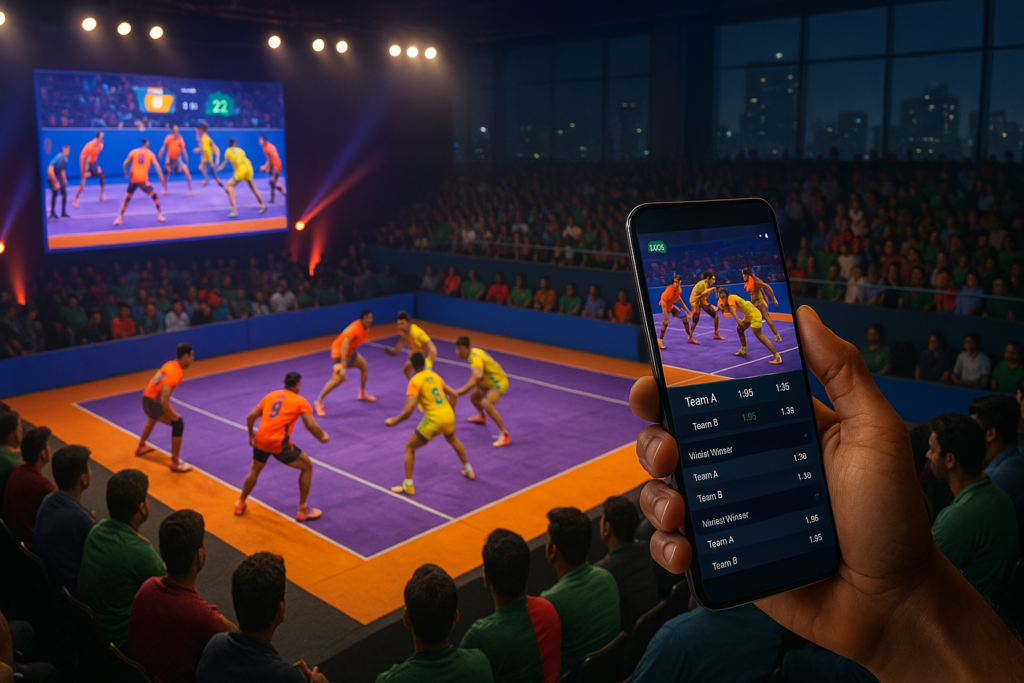
Kabaddi: Bangladesh’s National Game in a New Light
Kabaddi has been Bangladesh’s national sport since the early 1970s, and the game’s local form, ha-du-du, still survives in fields and schoolyards far from Dhaka’s flyovers. The Bangladesh Kabaddi Federation, founded in 1973, has spent decades turning that raw, rural game into an international discipline with codified rules, coaching, and selection pathways.
Results followed. The Bangladesh national team won silver medals in men’s kabaddi at the Asian Games in 1990, 1994, and 2002, and bronze medals in 1998 and 2006. At the World Cup level, Bangladesh has also finished on the podium, third in 2004 and 2007. In these tournaments, the country is usually chasing India, but it does so as a recognised power rather than a curiosity.
This context is important when we discuss betting. In Bangladesh, kabaddi is not a niche; it is a point of identity. When a Bangladeshi raider steps into the Pro Kabaddi League, the emotion back home is closer to a national team debut than a simple club signing.
Pro Kabaddi League: From Rustic Sport to Measured Spectacle
When the Pro Kabaddi League launched in India in 2014 under Mashal Sports, even optimistic observers did not expect it to become the country’s second-most-watched sports league after the Indian Premier League. Yet that is what has happened: millions now tune in for seasons featuring 12 franchises, including Patna Pirates, Jaipur Pink Panthers, Dabang Delhi KC, Bengal Warriors, and U Mumba.
Crucially, PKL is built like a data engine. The double round-robin format and playoffs create long, predictable schedules, with each team playing dozens of matches per season. Every raid and tackle is logged: raid points, tackle points, super raids, do-or-die raids, successful tackles, even the efficiency of specific left-corner and right-cover combinations.
Stars like Pardeep Narwal, who became the league’s all-time leading raider with well over 1,700 raid points, and Fazel Atrachali, who sits atop the tackle-points lists, function almost like living graphs. For fans inclined to think in percentages, PKL offers the kind of dense statistical history that traditional kabaddi never had.
Bangladeshi Players on the PKL Stage
Bangladesh’s relationship with PKL is not only that of a spectator. Over the past decade, a steady stream of Bangladeshi players have crossed the border to play in the league. Ziaur Rahman, a bronze medallist at the 2006 Asian Games, played for Puneri Paltan and became a minor cult figure as a Bangladesh Army officer, holding his own against India’s best.
Later seasons brought more names. Tuhin Tarafder and Masud Karim were among the Bangladeshi internationals selected in the PKL Season 8 auction, thereby expanding the country’s presence across different franchises. More recently, the Bangladesh Kabaddi Federation has submitted a record number of players to the PKL auction pool, with lists of ten men, including Md Mijanur Rahman, Liton Ali, and Sha Md Shahan, shortlisted for Season 12 in 2025.
For viewers in Dhaka, Chattogram, or Sylhet, seeing those names scroll across the bottom of the screen hooks national pride to league tables, tackle counts, and win probabilities. When the same stars appear in international tournaments, the PKL numbers serve as a reference point: evidence of how strong a squad really is.
Law, Risk, and the Bangladeshi Reality
Here, the Bangladeshi context must be stated plainly. Gambling is illegal in Bangladesh under the long-standing Public Gambling Act of 1867, and recent reforms have further restricted it. Authorities such as the Criminal Investigation Department have launched nationwide crackdowns on online gambling networks and mobile money agents handling betting payments.
While research sites, tipsters, and bookmaker reviews might frame PKL as a profitable playground, Bangladeshi residents themselves face serious legal and social risks if they act on that hype. For them, the “smart” way to use PKL’s numbers is often purely observational: learning to read momentum, understanding strategy, appreciating how fitness and psychology shape the outcome of a raid without turning that knowledge into real-money wagers.
Between Data and Desire: A Cautious Afterword
At a regional level, however, kabaddi is already embedded in the digital betting ecosystem. Specialist blogs rank kabaddi bookmakers; platforms cover the Pro Kabaddi League, the Bangabandhu Cup, and the Asian Championships, with live odds, cash-out tools, and in-play graphics. In promotional materials for international bookmakers, kabaddi now sits beside football and cricket; online platforms highlight Pro Kabaddi raid lines, team totals, and season-long futures for fans in jurisdictions where wagering is regulated. Many of the fans now use melbet download, creating a peculiar vantage point for Bangladeshi kabaddi lovers. They watch a league that speaks their sporting language, follow countrymen who raid and tackle on Indian mats, and see the same data streams that foreign bettors use as inputs. The temptation is obvious; the legal and personal consequences are just as real.
Ultimately, the most valuable “smart tool” that PKL offers Bangladesh may not be a route into markets at all, but a way of thinking: disciplined, pattern-based, respectful of risk. The league’s numbers do not only describe who wins; they also tell stories about preparation, patience, and the cost of one reckless lunge. In a country where kabaddi is the national game and gambling is forbidden, that quiet lesson may be the one worth betting your attention on.